Simplified Text Version of Platinum Processing Flow and Passive Processing Methods
此页面有 中文 版本
当前正在浏览 English,可一键切换到你的偏好语言 中文。
Author: @s6014770
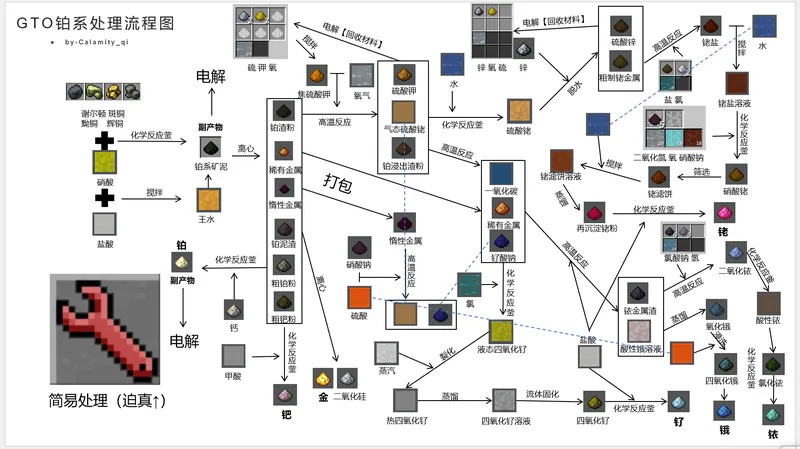
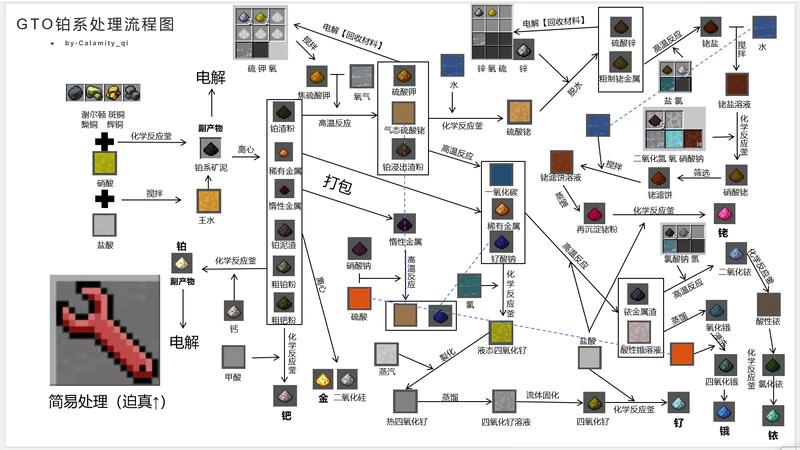
First, attached is the complete flowchart of 铂处 from the group; just edit directly wherever there are places that need optimization.
If you just want the results, jump straight to Part 1 and Part 4.
1. Raw Material Acquisition
Most compounds rely on requesters to generate samples, while some elements have complete cycles and only require proper recycling.
Nitric Acid: If the End is unlocked, you can collect nitric acid directly in the End using an HV Air Purifier; otherwise, use a Requestor to maintain stock.
Sulfuric Acid: Similarly, use an air purifier in the Nether
Hydrochloric Acid: Requester, chlorine + hydrogen. Hydrochloric acid is needed elsewhere, so it pays to stock up.
Obtaining Nitrogen, Hydrogen, Oxygen and Chlorine: You can just run small steam centrifuges continuously for nitrogen and oxygen; for hydrogen, use one electrolyzer to electrolyze water; for gaseous chlorine, use an evaporation tower (you can also obtain sodium hydroxide simultaneously).
Other materials:
Potassium pyrosulfate, soda ash powder, sodium nitrate, sodium chlorate powder, nitrogen dioxide, formic acid, ammonium chloride: You can use the requester to prepare the sample. Note that the byproduct sodium sulfate from formic acid can be recovered via electrolysis
Salt: It's produced and used in large quantities, so there shouldn't be a shortage
Calcium Powder: Only required for Platinum Powder; fully recovered via electrolysis of calcium chloride
Sulfur Powder: Some locations consume sulfur and it cannot be fully recycled. If you are short on it, get it from mines, or craft Centrifugal Blaze Powder (EV tier, slaughterhouses should have them, right?)
Zinc powder: Can be fully recovered from electrolytic zinc sulfate powder
2. Linear Organization of Text
The Platinum Series has six initial products, and some steps will also produce these initial products
1. Platinum slag powder, yields 6
1.1 High-temperature reaction: Add 6 platinum slag powder, 11 potassium pyrosulfate, 1 oxygen, producing 5 platinum leaching residue, 0.5 gaseous rhodium sulfate, 7 potassium sulfate powder (electrolytic recovery) (This step consumes 4 oxygen and 1 sulfur)
1.1.1 High-temperature reaction: Add 11 soda ash powder and 3 oxygen to 40 platinum leaching residue, producing 20 rare metal mixture, 21 sodium ruthenate and 3 carbon monoxide (electrolytic recovery) (Sodium-carbon conservation applies in this step) (This line ends; the rest will be covered in inert metal and rare metal processing)
1.2 Reactor: Gaseous rhodium sulfate turns into rhodium sulfate when water is added
1.3 Dehydrator process: Add zinc to rhodium sulfate to produce crude rhodium metal powder and zinc sulfate powder (recovered via electrolysis)
1.4 High-temperature reaction: Crude rhodium metal powder, add salt and gaseous chlorine to produce rhodium salt powder
1.5 Mixer: Add rhodium salt powder to water to produce a rhodium salt solution
1.6 Add oxygen, nitrogen dioxide, and sodium nitrate powder to the rhodium salt solution in the reaction kettle to produce rhodium nitrate powder and salt
1.7 Sifter for rhodium nitrate powder, produces rhodium filter cake powder,
1.8 Add water to the rhodium filter cake powder in the mixer to produce a rhodium filter cake solution
1.9 Distillation Chamber (Note) Circuit 1, produces 6 reprecipitated rhodium powder
1.10 Reaction Kettle 7 reprecipitates rhodium powder, adds hydrochloric acid, and produces 1 rhodium powder, 6 ammonium chloride, and 1 hydrogen gas
Congratulations, you've completed the rhodium processing!!!
2. Crude palladium powder, output 3
Add formic acid to the reaction kettle to obtain palladium powder, ammonia, and carbon monoxide
3. Crude platinum powder, output 2
Reactor 3: Add 1 calcium powder to 3 crude platinum powder, yielding 1 platinum powder and 3 calcium chloride (calcium recovered via electrolysis)
4. Platinum Sludge Residue, Yields 2
Centrifuge 5 platinum mud residue to obtain 3 gold powder and 2 silica powder
5. Inert Metal Mixture (Output: 4) (Ruthenium Treatment)
5.1 Baler Packing
5.2 High-Temperature Reaction: 6 Inert Metals + 10 Sodium Nitrate + 1 Sulfuric Acid, producing 6 Sodium Ruthenate and 0.6 Gaseous Rhodium Sulfate (see 1 for rhodium treatment)
5.3 Reactor 7: 7 sodium ruthenate + 3 chlorine produces 3 liquid ruthenium tetroxide and 12 salt
5.4 Cracking Machine No.1 Circuit, 1 Liquid Ruthenium Tetroxide + 1 Steam, produces 1 Heated Ruthenium Tetroxide
5.5 Distillation Column 3: Heated ruthenium tetroxide produces 2 salts, 1 water, 0.9 ruthenium tetroxide solution
5.9 Fluid Curing Machine: 1 Ruthenium Tetroxide Solution becomes 5 Ruthenium Tetroxide Powder
5.10 Reactor: 5 ruthenium tetroxide powder + 6 hydrochloric acid, produces 1 ruthenium powder, 2 water, 6 chlorine
6. Rare Metal Mixture (Yield 1) (Notably, primary source is platinum slag powder) (Iridium and Osmium processing)
6.0.1 Baler Packing
6.0.2 High-temperature reaction 7 Rare Metal Mixture + 4 Hydrochloric Acid, produces 5 Iridium Metal Slag + 1.6 Acidic Osmium Solution
6.1 Iridium Processing
6.1.1 High-Temperature Reaction: 6 Iridium Metal Slag + 1 Hydrogen + 5 Sodium Chlorate Powder, yields 3 Iridium Dioxide Powder, 2 Salt, 1 Dilute Hydrochloric Acid (distill to recover hydrochloric acid), has a chance to produce Platinum Mud Slag
6.1.2 Reactor 3 iridium dioxide powder + 1 hydrochloric acid, produces 1 iridic acid
6.1.3 Reactor 1: 1 acidic iridium + 18 ammonium chloride, produces 4 iridium tetrachloride + 2 ammonia
6.1.4 Reactor 4 iridium chloride + 3 hydrogen gas, produces 1 iridium powder + 3 hydrochloric acid
6.2 Osmium Processing
6.2.12 Distill acidic osmium solution in a distillation column, yields 5 osmium oxide metal powder + 1 water + 1 hydrochloric acid
6.2.27 Chemical immersion washer: Osmium metal powder + 1 sulfuric acid, produces 4 osmium tetroxide powder + 2 dilute sulfuric acid
6.2.35 Reactor: Osmium tetroxide powder + 4 hydrogen gas yields 1 osmium powder + 4 water
3. Organize the input entries for certain recipe types
1. High-temperature reaction
1.1 Platinum slag powder, Potassium pyrosulfate, Oxygen,
1.2 Platinum leaching residue, soda ash powder, oxygen
1.3 Crude rhodium metal powder, salt, gaseous chlorine
1.4 Inert Metals, Sodium Nitrate, Sulfuric Acid
1.5 Rare Metal Mixture, Hydrochloric Acid
1.6 Iridium metal slag, Hydrogen, Sodium chlorate powder
2. Large Chemical Reactor
2.1 Gaseous Rhodium Sulfate, Water
2.2 Rhodium salt solution, Oxygen, Nitrogen dioxide, Sodium nitrate powder
2.3 Reprecipitation of rhodium powder, hydrochloric acid
2.4 Crude Palladium Powder, Formic Acid
2.5 Coarse Platinum Powder, Calcium Powder
2.6 Sodium Ruthenate, Chlorine
2.7 Ruthenium Tetroxide Powder, Hydrochloric Acid
2.8 iridium dioxide powder, hydrochloric acid
2.9 Acidic Iridium, Ammonium Chloride
2.10 Iridium chloride, Hydrogen
2.11 Osmium tetroxide powder, hydrogen gas
Fluid: Water, Oxygen, Nitrogen Dioxide, Hydrochloric Acid, Formic Acid, Chlorine, Hydrogen
4. Specific Passive Implementation Methods
Requires a Reactor, Large Chemical Reactor, and Distillation Tower. No need to craft new ones; just use the ones you already have.
1. Distillation Column
It is recommended to use an ME Input Bus (or Precision Export Bus) — this is also needed for woodworking. You can mark multiple items without worrying about residual liquid clogging the input. Mark heated ruthenium tetroxide, dilute hydrochloric acid, dilute sulfuric acid, and acidic osmium solution.
2. High-temperature Reaction
Assuming your reactor is also used for producing titanium ingots and other items, and your pattern provider is facing one input assembly, enable isolation on the original input assembly (though it's not necessary, as reactors rarely mix recipes).
Add two more input assemblies, isolation is optional, enable input restriction. Install the AE output bus.
First marker platinum slag powder, potassium pyrosulfate, platinum leaching residue, soda ash powder, crude rhodium metal powder, salt, gaseous chlorine, oxygen
Second marker inert metal, sodium nitrate, rare metal mixture, iridium metal slag, sodium chlorate powder, hydrogen, hydrochloric acid, sulfuric acid
3. Large Chemical Reaction Kettle
Same as above: add 3 input assemblies to the large chemical reaction setup, fully enable isolation and input restrictions. (Actually, the only substance that needs isolation is hydrogen)
First marker: gaseous rhodium sulfate, rhodium salt solution, sodium nitrate powder, oxygen, nitrogen dioxide, water
Second mark reprecipitation: rhodium powder, crude palladium powder, crude platinum powder, calcium powder, sodium ruthenate, chlorine, ruthenium tetroxide powder, iridium dioxide powder, formic acid, hydrochloric acid
The third marker: acidic iridium, ammonium chloride, iridium chloride, osmium tetroxide powder, hydrogen
4. Other Simple Steps
Most output buses that can be directly AE'd. It is recommended to use the previous MV and HV small machines. If the machine is still used for prototype synthesis, pay attention to whether residues will cause blockages. If there is a universal factory, add an input assembly.
Dehydrator rhodium sulfate plus zinc
Add water to rhodium salt powder in the mixer, add water to rhodium filter cake powder
Rhodium Nitrate Powder Screening Machine
Distillation Chamber No. 1 Circuit, Rhodium Filter Cake Solution
Cracker No.1 Circuit, Liquid Ruthenium Tetroxide + Steam (Single Input Assembly)
Centrifuge Platinum Sludge Residue
Fluid Solidifier Ruthenium Tetroxide Solution
Chemical immersion cleaner Osmium oxide metal powder +1 sulfuric acid
Baler for two types of fine powder (may require precise bus output)
V. Electrolytic Recovery of Byproducts
Potassium sulfate powder, carbon monoxide, sodium sulfate (formic acid byproduct), calcium chloride